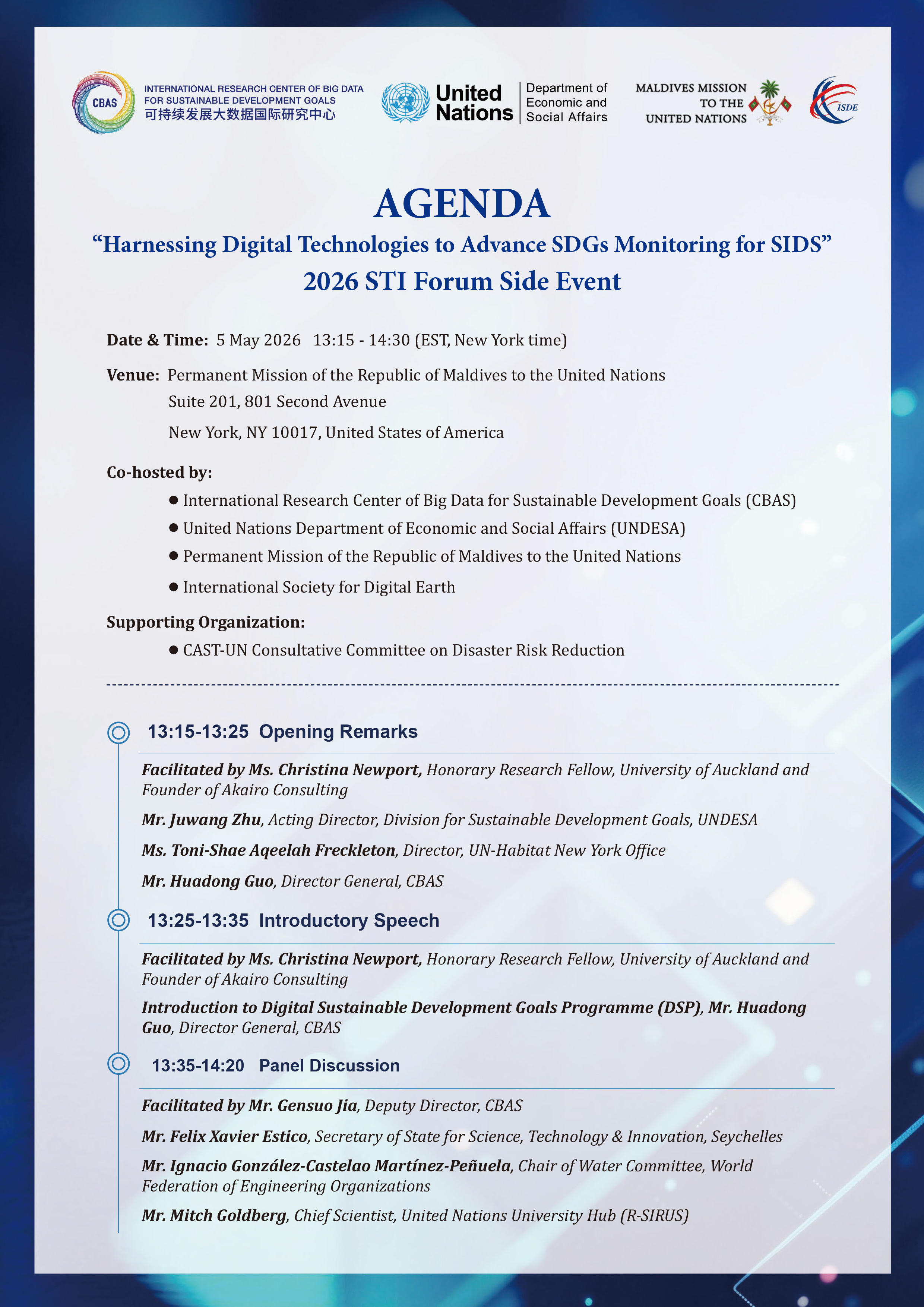
Agenda
“Harnessing Digital Technologies to Advance SDG Indicator Monitoring”
2026 STI Forum Side Event
(Draft Zero)
Date & Time: 5 May 202613:15 - 14:30 (EST, New York time)
Venue: Meeting room XXX
Permanent Mission of the Republic of Maldives to United Nations
Second Avenue, 43 Street
New York, NY 10017, USA
Co-hosted by:
Facilated by Mr. Wei Liu, IATT Coordinator,DSDG, UNDESA
13:25-13:40 Keynote Speech
Facilated by Mr. Wei Liu, IATT Coordinator,DSDG, UNDESA
13:40-14:20Interactive Discussion
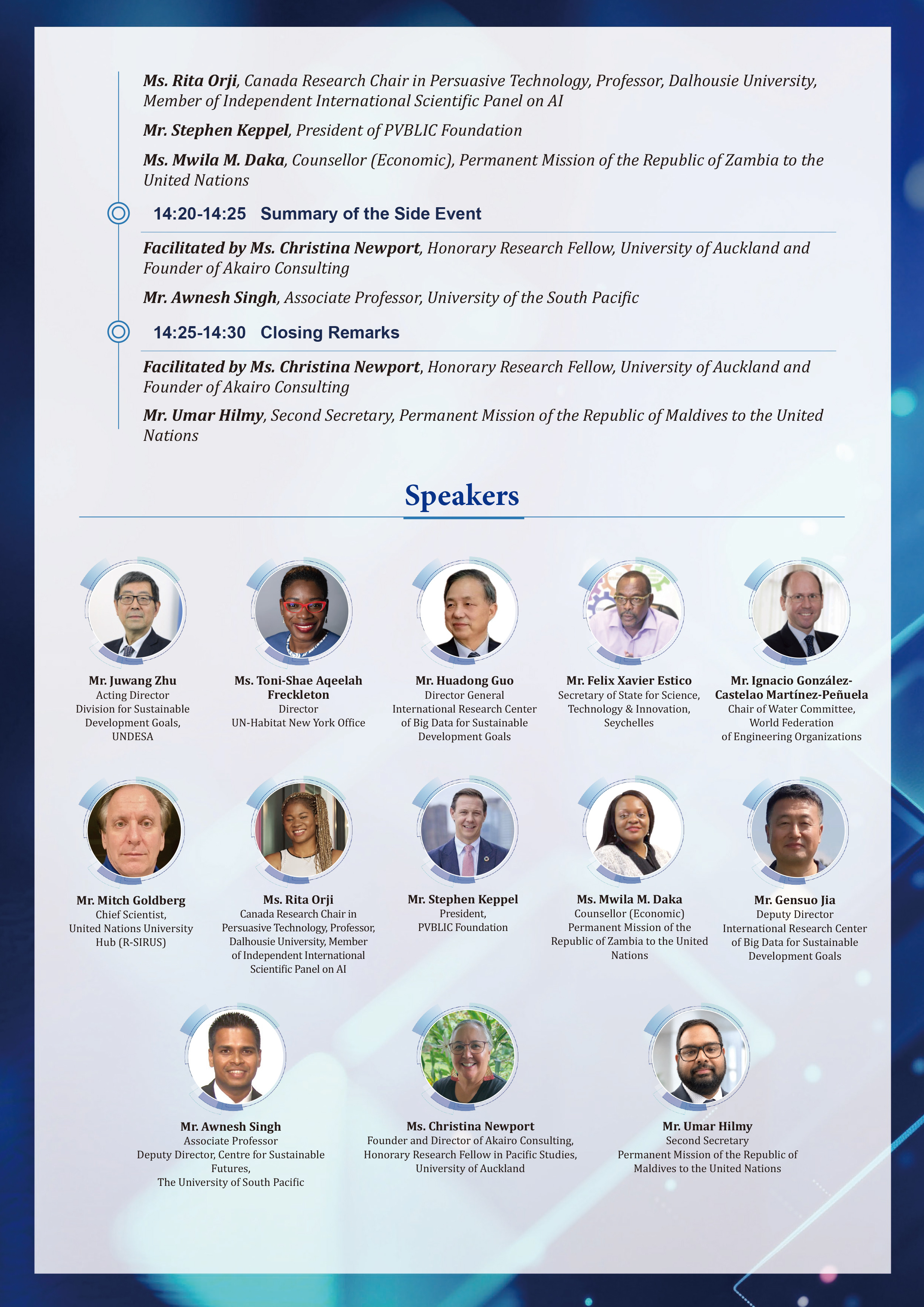
Facilated by Mr. Gensuo Jia, Professor, CBAS
14:20-14: 25 Announcement of the International Consensus Document
Facilated by Mr. Zhongchang Sun, Professor, CBAS
“Regional Demonstration and Pilot Research for Small Island Developing States (SIDS) under the Digital Sustainable Development Goals Programme (DSP) Framework”
14:25-14:30 Closing Remarks
Facilated by Mr. Zhongchang Sun, Professor, CBAS
Annex I
Guiding questions for Interactive Discussions
·Addressing Data Gaps in SIDS:“Small Island Developing States face unique structural challenges in SDG monitoring, including limited in-situ data collection capacity and geographic isolation. How can the DSP framework, through satellite observation systems like SDGSAT-1 and AI-powered analytics, effectively bridge these persistent data gaps particularly for indicators related to coastal ecosystems, water resources, and climate resilience?”
·From Static Reporting to Dynamic Monitoring: “Traditional SDG reporting often relies on static, lagging indicators. How can AI-enhanced, cloud-enabled digital indicator systems transform SDG monitoring into real-time, dynamic decision-support tools for SIDS policymakers? What concrete examples from the six interconnected domains (ecosystems, urban systems, food systems, energy, water, and climate-disasters) demonstrate this transformative potential?”
·Interoperability and Open Science: The DSP promotes open science principles and shared digital public goods. What interoperable data standards and collaborative frameworks are essential to ensure that AI-driven digital indicators remain accessible, scalable, and adaptable across different SIDS regions (AIMS, Caribbean, and Pacific)?
·Capacity Building and Technology Transfer: Drawing from the Beijing SIDS Workshop experience, what sustained capacity-building mechanisms such as training on Digital technologies are most critical for enabling SIDS institutions to independently monitor SDG progress? How can partnerships between CBAS, UN agencies, and SIDS governments institutionalize these capabilities at the national level?"
·Science-Policy Interface: How can digital technologies strengthen the science-policy interface in SIDS, enabling evidence-based decision-making for sustainable development? In what ways can AI-derived insights from digital indicators directly inform national STI roadmaps, climate adaptation strategies, and the implementation of the Antigua and Barbuda Agenda for SIDS (ABAS)?"
·Towards a Shared Vision for Post-2030: As we look beyond 2030, what shared commitments should the international community make to scale digital innovation for SDG monitoring in SIDS? How can this side event catalyze coordinated investments, sustained
satellite data-sharing mechanisms, and global partnerships that position digital technologies
and AI as trusted, enabling forces for sustainable development governance in the post-2030 era?"
Contacts for further informaiton
CBAS--Ms. Xiaolan Du- xldu@cbas.ac.cn
Maldives Mission--Mr. Umar Hilmy-umar.hilmy@foreign.gov.mv
UNDESA--Ms. Cathy Zhang- xinyi.zhang@un.org