With just five years remaining to meet the 2030 deadline of the Sustainable Development Goals,a new international study published in the Proceedings of the National Academy of Sciences (PNAS) finds that global progress has stalled or reversed for many goals at higher levels. While gains are being made in lower-baseline areas, the researchers warn that most countries remain off track to achieve the Sustainable Development Goals (SDGs) under current trends.
Innovation vs. health: the great divide
The research highlights a sharp contrast in global performance. Indicators related to Industry, Innovation, and Infrastructure (SDG 9) have shown the strongest performance globally. Conversely, despite high initial scores, Good Health and Well-being (SDG 3) has recorded the worst performance, with regression in vaccine coverage and infectious disease management stalling progress even in developed economies.
Lead author Qiang Xing, an associate professor at the International Research Center of Big Data for Sustainable Development Goals (CBAS), Chinese Academy of Sciences (CAS), observes: “The data reveals a striking paradox. While we have successfully leveraged industrial modernization and scientific research to move the needle of the SDGs, our global health foundations are cracking under the strain. This 'Great Divide' warns us that technological progress (SDG 9) alone cannot compensate for the systemic neglect of public health infrastructure and immunization systems (SDG 3), particularly as we move toward the 2030 deadline.”
The study, led by an international group of scientists, reveals that while indicators with low scores in 2015 have made progress, severe stagnation or regression is observed in achieving goals with high scores, depicting significant challenges in the "final stretch."
Progress at low levels
“The study reveals systematic differences in SDG progress across baseline levels in 2015. Much progress has been made for low-scoring SDG indicators in 2015,” highlights co-author Prajal Pradhan, an assistant professor at the University of Groningen in the Netherlands and a CAS President’s International Fellowship Initiative (PIFI) fellow. “For example, Sierra Leone has emerged as the global leader in progress for low-scoring indicators. The nation has made historic strides in female literacy and road safety, proving that rapid transformation is possible even in resource-constrained environments.”
The study also exemplifies Saudi Arabia’s efforts to eradicate poverty. Through robust, data-driven social protection programs, Saudi Arabia leads the world in eliminating poverty, with a projection to reach the goal by 2030. Another example is Vietnam’s Institutional Excellence. Vietnam has set a global standard for zero hunger by integrating institutional agricultural policies that prioritize long-term food security over short-term gains.
Challenges in the final stretch
The study shows that SDGs with high scores (i.e., 70–90%) in 2015 are now more likely to regress or stagnate than to advance. Limited focus of high-income countries on implementing SDGs in-house, the COVID-19 pandemic, and ongoing geopolitical conflicts are some reasons behind this regression and stagnation.
The study warns that these “regression trends” reflect challenges in achieving the SDGs in the final stretch, creating a vacuum in global sustainability leadership. For example, significant retreats in areas such as vaccine coverage and the rule of law are observed for Croatia, while environmental nitrogen management is increasingly a bottleneck for Portugal.
Call for SDG acceleration
“By 2030, the global SDG score will reach approximately 63%, with a few countries below the score 50%, e.g., Afghanistan, Somalia, and Syria. Countries need to achieve an annual growth rate of 4% to meet the overall SDGs by 2030,” says Chaoyang Wu, corresponding author and professor at the Institute of Geographical Sciences and Natural Resources Research, CAS. “In making SDG progress, New Zealand & Denmark remain at the global apex for Gender Equality (SDG5) and Global Partnerships (SDG17), respectively, serving as the North Star for systemic equity and public-private collaboration.”
Fang Chen, co-author and the Deputy Director General of CBAS, emphasized that this comprehensive long-term assessment provides an essential contribution to accelerating country-specific SDG efforts during this critical two-thirds term, complementing UN reports. “Our results systematically identify the differences among countries in terms of how far they have come and how far they must go to achieve sustainable development from pre-2015 to 2030. There is an urgent need to reinforce the international collaboration, funding, and aid to accelerate the SDG implementation and beyond.”
Although fully achieving all the SDGs in the remaining five years will be challenging, every inch of progress matters. The SDGs remain the global framework for the sustainable transformation of our common future.
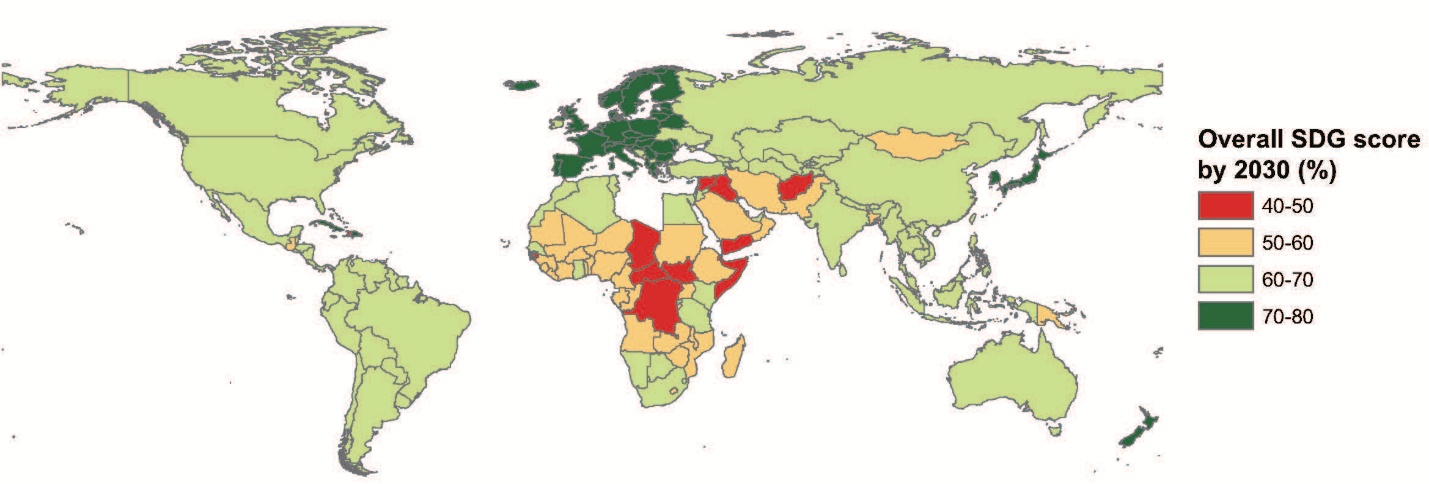
Image: Projected SDG scores by 2030, aggregated from the projected result at the indicator level. (Source: Xing et al. 2025)
Reference
Qiang Xing, Linlin Lu, Li Wang, Fang Chen, Jianguo Liu, Prajal Pradhan, Brett A Bryan, Enayat A. Moallemi, Lei Gao, Thomas Schaubroeck, L. Roman Carrasco, Dan Banik, Zhenci Xu, Yingjie Li, Linxiu Zhang, Tianran Ding, Jiuliang Liu, Yuxi Zeng, and Chaoyang Wu. Country-specific progress toward the sustainable development goals: Past, present, and prospects. Proceedings of the National Academy of Sciences (PNAS), 2025. https://doi.org/10.1073/pnas.2524299122.
Qiang Xing
International Research Center of Big Data for Sustainable Development Goals (CBAS)
Saurav Dhakal
Communications Consultant
Energy and Sustainability Research Institute Groningen (ESRIG)
University of Groningen